My mom came to pick me up from school this afternoon to go home for Thanksgiving. My younger sister Jess came with her. At 13, Jess is the youngest child in my family. Anywho, we were driving home and my mom looks at a sign and asks me if I know what Webkinz are. I had absolutely no idea and I told my mom this. Still wondering what a Webkinz was, we asked Jess if she knew what they were. I thought it was funny how my sister and I are different enough in age that she might have actually heard of this even if I had not.
Wednesday, November 21, 2007
Just ask everyone!
My mom came to pick me up from school this afternoon to go home for Thanksgiving. My younger sister Jess came with her. At 13, Jess is the youngest child in my family. Anywho, we were driving home and my mom looks at a sign and asks me if I know what Webkinz are. I had absolutely no idea and I told my mom this. Still wondering what a Webkinz was, we asked Jess if she knew what they were. I thought it was funny how my sister and I are different enough in age that she might have actually heard of this even if I had not.
Tuesday, November 20, 2007
What to do with a mint
As I was walking back from dinner, I wanted a mint and offered my friend one as well. We then started talking about mints and the different intensities of some different mints. While we were speaking about mints, I was trying to come up with the verb for what you do to a mint while you have one in your mouth. You don't really eat it, so what exactly do you do with a mint? So you suck on a mint? Or do you enjoy a mint? Or use a mint? Or have a mint? Neither my friend or I could figure out quite what you are doing when you have a mint in your mouth. It was rather interesting that there was no specific verb for a mint. There are some very specific verbs out there that are specialized for certain nouns. It seems odd that something as unique as a mint, with such a specific purpose does not have a special verb. The only reason that I can think of for this is that whenever you end up having a mint, you either say, "I really need a mint"-no reference to the actual time that the mint is in your mouth, or someone offers you a mint. In this case, they say to you, "Would you like a mint?" Again, no reference to the actual time the mint is in your mouth. Maybe, we just don't see the need for such a word. Or, maybe we just don't need to tell anyone what we are doing because after we are done, they know what we were doing.
Thursday, November 15, 2007
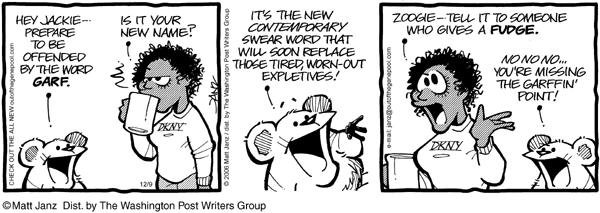
New Words... Dream On
Wednesday, November 7, 2007
My physics class was exciting today... but it wasn't related to physics
Earlier today I was sitting in physics class. I was listening to the professor, a difficult task at times. He was making a graph on the board. He was explaining that the graph was going to start at 0 meters and go to 1 meter. And it struck me. Why is it that we say one meter, but zero meters? Obviously the single meter is not going to be plural. That doesn't make any sense at all. But why is the absence of a meter plural? Why is it that we say something like "I have one dog, but no cats." What an interesting feature of our language. I am not sure at all how this works in other languages, but what a confusing thing to have to learn about a language--that the possession of many of the same object as well as the absence of the object is said the same, and both in the plural. The only reason why this could be that I came up with is that when we have zero, it is the absence of any number of this particular object. Meaning that by having zero, we can't have one or two or three or seventeen. We can have zero cats or five dogs or nineteen meters or one book. Plurals... what a funny thing.
Tuesday, November 6, 2007
If Dogs Could Talk... Would we know we were talking to a dog?
Dogs are almost always cute. But you always know when a dog is there. You hear panting, or a tail hitting the floor. You smell dog breath in your face. Or your face just got licked. It is always so easy to know where there is a dog near you. But how easy is it to know who you are talking to when you are online? Obviously, you would never actually be talking to a dog online. That is just impossible. And most of the time, you talk to your friends online, so you clearly know if you are talking to a girl or a guy. But if it is a stranger, how can you tell? Most of us are not that accustomed to the differences between men and women online. And every once in a while, a friend will be on someone else screen name, and unless they tell you who they are, often you will go on clueless. There must be certain differences that we might be able to pick up on. But it is also just as easy to pretend to be something that you aren't online. Because all that is exchanged is words on a screen, you can be very conscious about what you are saying and how you are saying it. And I am pretty sure that if dogs actually could talk, that often we would be unable to tell if we were talking to a guy, a girl, or a dog!
Home Language
A few weeks ago in class, we were talking about the English-only debate, and whether educating students in their family languages is a good or bad thing to do. My dad has four younger brothers. They all speak Dutch, but the two youngest speak more standard Dutch as opposed to the dialect that my dad, his two oldest younger brothers, and his father can all speak in. This is because when my middle uncle started going to school (in the Netherlands) he could not understand what the teachers were saying. At home he had learned to speak a dialect, and when standard Dutch was used in school, he could not understand. This prompted my dad's family to speak more standard Dutch when his two youngest brothers were born. While a dialect is not the same thing as a different language and the fact that this story deals with Dutch and not English, this story can still relate to the English only debate. While it would have been easier for my uncle to have been taught in his dialect in school because that was the language that he knew, it would not have helped him very much in life. If he had stayed in The Netherlands, he would have needed to learn the standard Dutch that everyone else spoke. And my dad's family switched to the standard English to make life easier for their children. It really does make sense for schools to teach children the language of the country because that is what they will need to know in order to survive. Taking this statement seriously is a little tricky since the United States does not have an official language. But seeing as how most people in this country speak English, and many people all over the world speak English, children should be taught standard English in school. Granted this is pretty much the case in this country now, the tricky part now is how to teach any and every student English in school.
Monday, November 5, 2007
A Walk to the Bus Stop
Several years ago, way back in high school, my brother and I used to walk to the bus stop together. It must have been during my freshman year because my older brother was not driving to school yet. Anyways, we were walking and talking early in the morning. At one point, I just stopped responding to what he was saying. I was still listening to him, I just wasn't saying anything back to him. A moment of silence would pass, where normally I would have said something. Then, my brother would fill the silence and continue talking. I did this for maybe a minute or more before I informed him of what I was doing. I said something along the lines of, "Would you just keep talking if I never said anything?" This made me wonder if guys, particularly my brothers and dad would just keep talking if I never said anything in response to them. I know that a few times that week I tried it with my younger brother and my dad. Both of them proceeded to speak even though I was not responding to them. Every now and then I still do this, just to see if it still happens. Both of my brothers and my dad will all continue to talk to me, whether I respond or not. I wonder why this is. It could be that men will talk whether there is a response or not. They might not listen for a response at all and just talk on and on. It is possible that men often do not listen and participate in a conversation, they just speak what is on their mind.
Sunday, November 4, 2007
"I'm Sorry"... a sign of uncertainty?
Over the weekend, I was sitting with a bunch of other girls around a fireplace. One of the girls has this habit of saying "I'm sorry" all the time. She says this because she does not want to offend anyone with anything that she says. This habit has become such a part of her speech, that she says it even when it is not necessary at all to say "I'm sorry." It is interesting that a phrase that someone starts saying can defuse into the rest of her language, whether it fits or not. It is so easy for a phrase to become over used in our everyday speech. And when such a phrase is used so much, it begins to lose it's meaning.
We then started to talk about whether guys or girls say "I'm sorry" more. We determined that girls say "I'm sorry" a lot more often than guys say it. Thus we started to ponder on why this could be. It could just be that guys like to seem macho, and saying "I'm sorry" is a sign of weakness because that means that he messed up and did something wrong. It could also be that girls are more insecure and uncertain of what they say and where they stand on things. But saying "I'm sorry" with an opinion, it makes stating your opinion much safer. It is as if she is saying, "This is what I think, but its fine if you don't agree with me." It makes speaking safer because it protects your from offending anyone else. This follows what we were talking about in class last week. One of the differences between men and women speaking is that women tend to be more cautious about what they say. Women tend to be more inclusive. This example fits exactly into that point.
Monday, October 29, 2007
The Breakfast Club
This past weekend, my friends and I had a little bit of an eighties movies marathon. One of the movies that we watched was The Breakfast Club. Its about 5 kids from 5 totally different high school clicks each serving a Saturday detention. Seeing as how they have to spend 9 hours together, they eventually turn to each other for conversation, even though none of them have ever talked to each other, and never would have talked to each other during a normal school day. They don't exactly get along with one another, but at least they have someone to talk to. Most of the time is spent figuring out why each person does what they do and hangs out with who they do. At one point, the bad-ass, I don't care what I do, you don't tell me what to do character says to the Prom Queen/princess/daddy's little girl character, "You don't know me. We don't even speak the same language." Obviously he didn't mean that they both don't speak English. He meant that the types of lives that they lead and the types of people that they hang out with are so vastly different, that it can be difficult for them to communicate. Phrases can be translated differently amongst social clicks, and often not at all. Different ideas are thought and shared. There are completely different ways of thinking. These differences can be so large that it seems as though people from different social clicks are practically speaking different languages.
I had a similar experience myself in high school. It was the first or second day of the school year and a few of my friends and I were sitting at lunch. At the other half of the table were a few 'gansta' kids. Even visually there was quite a contrast between the 'gansta' kids and my friends and I. Then one of the 'gansta' kids said something. My friend Emily and I had absolutely no idea what he had just said and just started laughing. We continued to listen to them talk, not understanding, but still laughing at the fact that they were communicating to their friends and that their friends actually understood, which to us sounded like gibberish. It really is amazing how different the language between high school clicks and groups can actually be. Sometimes it is so extreme that there is a complete lack of understanding.
Friday, October 26, 2007
What did your dad say?
I was thinking about the story we read about Richard Rodriguez's childhood. At one point he was talking about how Spanish for him was his family's language. It was a special way for his family members to communicated with each other. It was something that they all had in common, something that bonded them together, something to belong to. This made me start thinking about my family. We speak English, and this obviously is not anything special that just our family does. I speak English with pretty much everyone that I know. My friends, classmates, and even strangers: I speak English to all of them. But there is still a certain uniqueness to the way that my family speaks. I realized this when I was on the phone with my dad last night. We were just talking about the most random things. The way that my dad says things is often quite different from the way most people would say them. About half the time when he tries to use a cliche of some kind, he mixes one or two together, and it comes out as some obscure phrase that no one has ever hear in his life. But, just because he is my dad and we are family, I understand perfectly what he is trying to communicate to me. It is part of our family language to know what these phrases mean. My dad also makes up words. Well, not completely makes up new words, he just changes words. Instead of saying, "Let's have some chips," my dad calls them chippies. If it's a hot summer day out and we are all going to go swimming in the lake, my dad will say, "Let's put our swimmies on." If I have a friend over and they hear this, they just look at me with this puzzled look on her face. Once I translate this family language to my friend the confused face is gone, but I can still tell that it is weird for her. It is just something different for my friends, just because they do not speak my family's special language.
Sunday, October 21, 2007
A Standard American?
Last class, we talked a little about if the United States should declare English (and possibly other languages) as official languages. We read two different articles about the different pros and cons about such an action, and if it was actually necessary, and if we should require all new US citizens to learn English. As of now, it is possible to function and live in this country without actually being able to speak English. The written test for getting a drivers license can be taken in other languages. In some places, voting ballots are available in a variety of different languages. But this country has not always been so accommodating to immigrants who speak different languages. This country used to make new comers conform much more than they do now. I remember in elementary school when we learned about all the immigrants who came in through Ellis Inland and the like. Often new immigrants were forced to change their last names so that they would be easier to spell and seem more American. This was partly to make their lives easier with a more American name, but also because foreign names are almost impossible to spell. In the past we forced immigrants to conform to American ways. So, when and why did this change so drastically?
Thursday, October 18, 2007
What defines us?
I just read a blurb from one of my RA's. It was about identity and what he actually considers himself. He is of Indian heritage, but when he goes over to India to visit his family, he does not actually fell Indian. This (and the two things I am reading for class today) got me to thinking about what I consider myself. I have always said that I was Dutch, as both of my parents were born in The Netherlands. I, on the other hand, was born in the United States. But I still considered myself to be Dutch. But the more I think about this, the less I think I actually should consider myself Dutch. I do not speak Dutch. Since speaking a language is such a big part of identity, I guess I should consider my American because I speak English. Although my heritage is Dutch, I am not truly Dutch. I am an American.
Sunday, October 14, 2007
From Way Down South
This weekend, I spent a two days in Boston with some of my friends. One of my friends brought her roommate with her. Her roommate is from the South, originally from Louisiana and currently living in Mississippi (well, when she is not at college). She was really fun, not only to be around, but to listen too. It is interesting how different our perceptions of certain people can actually be from reality. I have always though that a southern accent would drive me absolutely crazy because of both the different accent and the drawl, the way people from the South tend to speak slower. When my friend told me that her roommate was from Mississippi, I was a little reluctant to actually meet her. But, what I thought she would be like and what she was actually like, accent and speaking wise, were drastically different. She did have the southern accent, but it was not overbearing at all. In fact, it was really adorable. And the southern drawl that I was afraid of, was completely non-existent. We all have different ideas of how people from different regions sound. And these perceptions are not completely ridiculous because there are certainly people from the region who actually speak that way. But for each person who does fit the perception (and it is these people that the perceptions are based on) there is another person who does not fit. These are the people who make the language in this country so interesting to listen to, no matter what part of the country you happen to be in.
Sunday, October 7, 2007
Where are you from?
Yesterday, I was walking back from the football game with a few people. The conversation turned towards where we each were from. One girl was from Long Island. She then proceeded to explain to us how some people from Long Island pronounce Long Island. (I would try to explain it here, but I have no idea how I would explain it, or even exactly how it sounds when a native speaker pronounces it in this particular way.) A few of us then tried to imitate this particular pronunciation. To our ears, our pronunciation sounded exactly the same as when the Long Island native pronounced it, but this girl could tell that we were not saying it correctly. This is what I found interesting: that we can only hear certain differences in pronunciation when we are actually from that specific area that happens to pronounce certain words differently. If our ears are not used to hearing words pronounced a certain way, we can not tell if we are actually mimicking the pronunciation or not. Only when we have lived in that particular area for a long time can we tell a real speaker from a fake.
Wednesday, October 3, 2007
What??? (in writing)
Walking around campus, I always see different things written in chalk on the sidewalks. It makes a lot of sense to tell others about events or almost anything this way because all of the students spend a lot of time walking around from class to class. One that I saw recently said "Google Ron Paul." This one was obviously trying to get people to find out more about the candidate Ron Paul, and hopefully, by getting people more interested in him, have more people vote for him. What was really interesting about this particular chalk writing was that not too far away, facing the other direction is a chalk writing that says "Who is Ron Paul?" What I found interesting about this one is that I, as the reader, do not know if this is supposed to be a question and that this chalk writing is hoping to have a similar effect as the first one. By asking a question, the writers of this chalk writing may be hoping to start some curiosity in the readers. But this chalk writing could also mean something completely different. It could be mocking the first chalk writing. As the reader of this chalk writing, I do not know what this second chalk writing is supposed to mean. In written language rather than in spoken language, it can be much harder to grasp the meaning of words. When someone is speaking, as the listener, it is easy to tell what they mean because you can hear emphasis and tone. But when something is written, these things can be much harder to find and know, thus making the meaning of such language much harder to understand.
Sunday, September 30, 2007
Wicked is wicked catchy
Today my dad came back on a flight from Europe and brought a Dutchman home for a cup of coffee. This man was born in the Netherlands, but moved to New Hampshire in 1982, or some time around then. Even though he has lived here for quite a while, he still has a rather thick accent. I was baking some bread in the kitchen and just casually listening to their conversation. At one point, I heard this man use the word "wicked." It was used perfectly, like any other New Englander would use it. It was interesting that this man who has lived in this area for quite a while has picked up on the regional words and in what context they are used. It was also cool to hear wicked said in a thick accent. This man may stick out because of his accent, but he won't stick out for not knowing the regional words.
Like is umm, like cool
You don't notice it that much when you listen to someone talk just in a conversation, but when listening to something recorded, you notice things about spoken language much more. When listening to my recording of my friend and transcribing it, I hear all sorts of interesting things in the way that she talks. I picked up on these things because I wasn't listen to her sentences, but I was actually listen to her words. Two things that I noticed a lot while transcribing were her use of umm and her use of like. Sometimes people use like as a stale word when they do not know what to say. But my friend did not do that. She used the more traditional stale words like ummm, and yeah, and so. Like was only really used in place of says or something like that. She would be like I went to the mall with my friend because thats one of our favorite things to do. This isn't to say that she never used like as a stale word, but it was less often. It is interesting on how many different things that you hear when you are not listening to respond to what someone says, but are just listening to the words that they are speaking.
Wednesday, September 26, 2007
Is that something dirty???
Last we in class, we took a survey on language trends in the New Hampshire and Vermont area. One of the questions asked something about what I call soft ice cream (as in not the hard stuff that you scoop out, but the creamy stuff that comes out of the machine). Some of the answers were soft serve, soft ice cream, and things like that. The one that I picked (because that's what I call this kind of ice cream) was creemee.
I have known what a creemee is all my life. I spent my early childhood (from birth to about age six) in Vermont and my family would always go out for creemees during the summer. But apparently, no one from around here knows what a creemee is. I found this out a few summers ago. I was working outside with a bunch of other kids from my youth group. We had been working all day long, outside in the hot sun, and a few of us started saying things that would be just perfect right now. I said that I could really go for a creemee right now. And everyone just stared at me like I was crazy or something. It took me a few minutes to figure out why they were so confused, because in my mind, I hadn't said anything worthy of such shock and confusion. Once we figured out what the difference was, I was shocked that my friends from New Hampshire had no idea what a creemee was. Granted I hadn't lived in New Hampshire my whole life, but Vermont is in the same part of the country. I mean, the states are right next to each other. I would think that something as common as soft serve ice cream would have the same name. The rest of that summer, I asked all of my friends if they knew what a creemee was. The most common and most comical response I got was "is that something dirty?" It took me a while to figure out that creemee must just be a Vermont word. Now, all of my friends know what a creemee is, but if I go to an ice cream stand and ask for a small vanilla creemee, all I receive is a very confused look from the person taking my order.
Friday, September 21, 2007
With some lined paper and a pen...
Yesterday, I went to check my mailbox because I was walking through the MUB. I wasn't expecting anything, and when there were two letters in my mailbox I was really surprised and excited. One was a little note from my mom, and the other was a letter from my friend Karissa. Karissa is one of my oldest friends; we have known each other since first grade. It is always so exciting to get mail because seeing the words that someone wrote down on paper just for you to read is so touching. It can't be read on any computer screen, your cell phone where ever you happen to be, or heard where ever you happen to be. The words from this person can only be found on this one piece of paper. And this piece of paper was sent from where Karissa is to where I am. It's almost like a little tiny piece of her was sent to me in the mail. Letters and notes are so much more personal than any kind of electronic communication that we can use to keep in touch. It shows that someone cares enough for you that she actually took the time to find a piece of paper (a rare thing these days), get a pen, write words down, gather together an envelope and a stamp, find you address and put it in the mail. That is a lot of work compared to just writing an email. But getting a letter is so much more exciting and so much more personal. I can't wait to write Karissa back!
Monday, September 17, 2007
Understanding is easy... if you already know it
Almost everyone in this country, or most of the people we come into contact with everyday, speak English. But this does not mean that we can understand everybody just because they are speaking English. Regional dialects, accents, slang, vocabulary, and conditions can all make understanding someone speaking the same language as us easier or harder. Sometimes, there can be an accent, but because the vocabulary is familiar, the accent does not change our level of understanding. One excellent example of this is in my calculus class. The professor is Chinese and although he speaks English, he has an accent and his grammar and pronunciation are often not quite correct. But I understand perfectly what he says everyday in class. This is because I know the vocabulary that he is going to use. I expect him to use words like "derivative" and "integral." So, even if these words are not pronounced exactly as I say them or hear them, I know what he is trying to say, so I can understand him completely and correctly. It does not matter that he has a think accent and does not speak correct English all of the time, because I know the vocabulary and thus I understand his language.
Differences in regional dialects and regional slang or vocab can make conversations slightly confusing. When speaking with someone from a different region with numerous differences in language, the phrase "Wait! What did you say?" might be heard quite often. It only slightly slows the conversation down, but it is always interesting to hear how people from other regions speak. I remember a few years ago when my cousins from Idaho were visiting. We were just talking about who knows what, when one of my cousins said "Roof." But she pronounced is like "ruff," like a dog barking noise. We then argued about the real pronunciation of roof. We then decided to figure out what other words we say differently or have different words for. Another difference that we found was that here we call a little river-type-of-water flowing in our backyard a stream, while my cousins from Idaho would call it a creek. Except, they pronounced it like "crick" like a cricket. When conversing with my cousins, we have more difficulty because of the differences in how we pronounce things and the vocabulary of words that we use, not because there is an accent. My cousins do not sound much different from me when I speak. It is much easier to understand when the vocabulary is known, even when there is an accent present.
Friday, September 14, 2007
Its all in a name... or a nickname
There are some people whose name just fits them. She just looks like a Danielle or a Sarah. I couldn't tell you what exactly a Danielle or Sarah should look like, but you know when someone looks like their name. It doesn't happen often, but when it does it is so noticeable, it is astounding. These names are always easy to remember because, for some reason or another, the face triggers the mind to remember the name. But there isn't an abundance of people who look like their name, so we need to come up with other ways or either remembering names, or other names. Often what does happen, is that a person is given a nickname based on what they look like.
Now, when someone gives us a nickname like this, we usually are completely unaware that this nickname for us even exists. It is usually used when someone's real name is not know, but for some reason or another, this someone needs to be spoken about. Today I was sitting at lunch with a few friends, and one of them said, "I almost ran into glasses-kid today." Another friend then asked who glasses-kid was. Clearly glasses-kid is a kid with glasses, but since lots of people have glasses, it does not seem that this nickname would be overly useful in figuring out who glasses-kid actually is. But this guy actually looks like glasses-kid. If you saw him or walked past him, you would know that this guy is the guy called glasses-kid. It is quite interesting how you could have never seen this person in your life, only heard stories of him in which he was called glasses-kid, and when you meet him or see him for the first time, you would know exactly who he was. You know him because the nickname glasses-kid is so perfect for him. Our language and the words we use and the names we give people can be so perfectly descriptive.
A few minutes later, still at lunch, a guy from my dorm walked by and one of my friends called him over. She then proceeded to ask if she could call him Frodo. I know that you can picture him right now. And yes this guy has dark hair that sits in these little curls that float like a little fuzzy helmet over his head. Frodo is the perfect name for him because it tells anyone and everyone who has ever seen anything related to The Lord of the Rings movies would be able to pick this guy out of a crowd if you ask to pick Frodo out. Nicknames can be so perfectly fitting to someone, that no confusion could ever be made as to what his or her name was, or at least nickname was.
Now, when someone gives us a nickname like this, we usually are completely unaware that this nickname for us even exists. It is usually used when someone's real name is not know, but for some reason or another, this someone needs to be spoken about. Today I was sitting at lunch with a few friends, and one of them said, "I almost ran into glasses-kid today." Another friend then asked who glasses-kid was. Clearly glasses-kid is a kid with glasses, but since lots of people have glasses, it does not seem that this nickname would be overly useful in figuring out who glasses-kid actually is. But this guy actually looks like glasses-kid. If you saw him or walked past him, you would know that this guy is the guy called glasses-kid. It is quite interesting how you could have never seen this person in your life, only heard stories of him in which he was called glasses-kid, and when you meet him or see him for the first time, you would know exactly who he was. You know him because the nickname glasses-kid is so perfect for him. Our language and the words we use and the names we give people can be so perfectly descriptive.
A few minutes later, still at lunch, a guy from my dorm walked by and one of my friends called him over. She then proceeded to ask if she could call him Frodo. I know that you can picture him right now. And yes this guy has dark hair that sits in these little curls that float like a little fuzzy helmet over his head. Frodo is the perfect name for him because it tells anyone and everyone who has ever seen anything related to The Lord of the Rings movies would be able to pick this guy out of a crowd if you ask to pick Frodo out. Nicknames can be so perfectly fitting to someone, that no confusion could ever be made as to what his or her name was, or at least nickname was.
Tuesday, September 11, 2007
Making a language your own
Recently for my linguistics course , I read and essay by Barbara Mellix titled "From Outside, In" which described her experiences in learning how to write and eventually think in "Standard English" as opposed to the "Black English" she grew up in. Now, I have grown up in "Standard English" and speaking, writing, and thinking in it are completely normal for me. I do not really have any other language that I could think in. But for much of my family this is not the case. Both of my parents were born in the Netherlands and moved to the US, each with their respective families when they were about 18. Both of my parents are completely fluent in English now and only a trace of an accent remains. For my grandparents this is not quite the case. All three of my remaining grandparents have a fairly thick accent and I often hear them reaching for the correct English word when they are speaking. It isn't that they do not speak English, most of the time I understand what they are trying to communicate to me, but it is easy to see that there are times where speaking English is just not natural for my grandparents.
Anyways, after reading this essay by Barbara Mellix, I was reminded of two things. I have heard my mom several times talking about this one question that other people have asked her. The question is: when you think, do you think in Dutch or English or a mixture. I have never heard my mom's answer to this question, for she is not entirely sure herself, but it is still an interesting question. Although my mother grew up speaking Dutch, she uses English much more now. The other thought that came to my mind after reading this essay was in regards to the card my grandfather gave me for my graduation in June. It was a simple but pretty card with well chosen words on the inside and a lovely quote. But it was not the quote that struck me. After I finished reading the card, my grandfather asked me how the writing in the card was. I carefully reread the words inside, marveled for a moment at the handwriting (I love the look of the older European handwriting that I have only seen in cards from my grandparents) and turned to my grandfather. I told him that he had written well and that I found no mistakes. He seemed almost surprised that he had written in correct English and not made a single mistake. It seemed odd to me that even after having lived in the United States for over 25 years, my grandfather still did not trust his writing of the language. But I guess that a new language, especially written language, is one thing that may never belong to someone.
Subscribe to:
Posts (Atom)