Wednesday, November 21, 2007

Just ask everyone!


My mom came to pick me up from school this afternoon to go home for Thanksgiving. My younger sister Jess came with her. At 13, Jess is the youngest child in my family. Anywho, we were driving home and my mom looks at a sign and asks me if I know what Webkinz are. I had absolutely no idea and I told my mom this. Still wondering what a Webkinz was, we asked Jess if she knew what they were. I thought it was funny how my sister and I are different enough in age that she might have actually heard of this even if I had not.

Tuesday, November 20, 2007

What to do with a mint


As I was walking back from dinner, I wanted a mint and offered my friend one as well. We then started talking about mints and the different intensities of some different mints. While we were speaking about mints, I was trying to come up with the verb for what you do to a mint while you have one in your mouth. You don't really eat it, so what exactly do you do with a mint? So you suck on a mint? Or do you enjoy a mint? Or use a mint? Or have a mint? Neither my friend or I could figure out quite what you are doing when you have a mint in your mouth. It was rather interesting that there was no specific verb for a mint. There are some very specific verbs out there that are specialized for certain nouns. It seems odd that something as unique as a mint, with such a specific purpose does not have a special verb. The only reason that I can think of for this is that whenever you end up having a mint, you either say, "I really need a mint"-no reference to the actual time that the mint is in your mouth, or someone offers you a mint. In this case, they say to you, "Would you like a mint?" Again, no reference to the actual time the mint is in your mouth. Maybe, we just don't see the need for such a word. Or, maybe we just don't need to tell anyone what we are doing because after we are done, they know what we were doing.

Thursday, November 15, 2007

New Words... Dream On

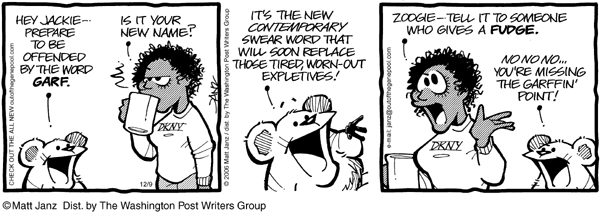
I recently read an article on what to do about the singular use of "their" as a gender neutral pronoun. One proposed correction of this, is to create a gender neutral pronoun that can be used instead of saying "their" or "he or she." The one flaw in this idea is that there is no way that a new pronoun could ever catch on. Some people may begin using it, but no one will know that they are talking about, so they will eventually abandon it and return to something that they and everyone else already knows and uses. I found a cartoon that shows how difficult it can be to create new words and to get them to stick and become part of the language that everyone knows and understands. If people are still holding on to their older swear words, how do people expect a new pronoun to ever catch on?

Wednesday, November 7, 2007

My physics class was exciting today... but it wasn't related to physics


Earlier today I was sitting in physics class. I was listening to the professor, a difficult task at times. He was making a graph on the board. He was explaining that the graph was going to start at 0 meters and go to 1 meter. And it struck me. Why is it that we say one meter, but zero meters? Obviously the single meter is not going to be plural. That doesn't make any sense at all. But why is the absence of a meter plural? Why is it that we say something like "I have one dog, but no cats." What an interesting feature of our language. I am not sure at all how this works in other languages, but what a confusing thing to have to learn about a language--that the possession of many of the same object as well as the absence of the object is said the same, and both in the plural. The only reason why this could be that I came up with is that when we have zero, it is the absence of any number of this particular object. Meaning that by having zero, we can't have one or two or three or seventeen. We can have zero cats or five dogs or nineteen meters or one book. Plurals... what a funny thing.

Tuesday, November 6, 2007

If Dogs Could Talk... Would we know we were talking to a dog?


Dogs are almost always cute. But you always know when a dog is there. You hear panting, or a tail hitting the floor. You smell dog breath in your face. Or your face just got licked. It is always so easy to know where there is a dog near you. But how easy is it to know who you are talking to when you are online? Obviously, you would never actually be talking to a dog online. That is just impossible. And most of the time, you talk to your friends online, so you clearly know if you are talking to a girl or a guy. But if it is a stranger, how can you tell? Most of us are not that accustomed to the differences between men and women online. And every once in a while, a friend will be on someone else screen name, and unless they tell you who they are, often you will go on clueless. There must be certain differences that we might be able to pick up on. But it is also just as easy to pretend to be something that you aren't online. Because all that is exchanged is words on a screen, you can be very conscious about what you are saying and how you are saying it. And I am pretty sure that if dogs actually could talk, that often we would be unable to tell if we were talking to a guy, a girl, or a dog!

Home Language

A few weeks ago in class, we were talking about the English-only debate, and whether educating students in their family languages is a good or bad thing to do. My dad has four younger brothers. They all speak Dutch, but the two youngest speak more standard Dutch as opposed to the dialect that my dad, his two oldest younger brothers, and his father can all speak in. This is because when my middle uncle started going to school (in the Netherlands) he could not understand what the teachers were saying. At home he had learned to speak a dialect, and when standard Dutch was used in school, he could not understand. This prompted my dad's family to speak more standard Dutch when his two youngest brothers were born. While a dialect is not the same thing as a different language and the fact that this story deals with Dutch and not English, this story can still relate to the English only debate. While it would have been easier for my uncle to have been taught in his dialect in school because that was the language that he knew, it would not have helped him very much in life. If he had stayed in The Netherlands, he would have needed to learn the standard Dutch that everyone else spoke. And my dad's family switched to the standard English to make life easier for their children. It really does make sense for schools to teach children the language of the country because that is what they will need to know in order to survive. Taking this statement seriously is a little tricky since the United States does not have an official language. But seeing as how most people in this country speak English, and many people all over the world speak English, children should be taught standard English in school. Granted this is pretty much the case in this country now, the tricky part now is how to teach any and every student English in school.

Monday, November 5, 2007

A Walk to the Bus Stop

Several years ago, way back in high school, my brother and I used to walk to the bus stop together. It must have been during my freshman year because my older brother was not driving to school yet. Anyways, we were walking and talking early in the morning. At one point, I just stopped responding to what he was saying. I was still listening to him, I just wasn't saying anything back to him. A moment of silence would pass, where normally I would have said something. Then, my brother would fill the silence and continue talking. I did this for maybe a minute or more before I informed him of what I was doing. I said something along the lines of, "Would you just keep talking if I never said anything?" This made me wonder if guys, particularly my brothers and dad would just keep talking if I never said anything in response to them. I know that a few times that week I tried it with my younger brother and my dad. Both of them proceeded to speak even though I was not responding to them. Every now and then I still do this, just to see if it still happens. Both of my brothers and my dad will all continue to talk to me, whether I respond or not. I wonder why this is. It could be that men will talk whether there is a response or not. They might not listen for a response at all and just talk on and on. It is possible that men often do not listen and participate in a conversation, they just speak what is on their mind.